Circular Science: Symmetry and Orbits in the Qur’an
"He is the One who created the night and the day, and the sun and the moon, each swimming in its orbit.” Surah Al-Anbiya (21:33)
The providence and sustenance of Al-Muqīt can be symbolically represented by a circle, a figure of perfection and completeness. Just as a circle has neither beginning nor end, the action of Al-Muqīt manifests at every moment of life, in every creature, and in every aspect of the universe. Each point of the circle depends on the others to maintain balance: similarly, all forms of life receive nourishment, protection, and guidance—physical, emotional, and spiritual—in perfect measure and at the right moment. The circle thus becomes a powerful symbol of continuous support, harmony, and universal interconnectedness guaranteed by Al-Muqīt.
The circle, both visible and invisible, permeates all of reality. From microphysics to the macrocosm, from biology to spirituality, from art to cosmology, it represents cyclicality, centrality, balance, and harmony, yet it also embodies illusion. Through an infinite, almost hypnotic cycle, it can deceive our perception of movement and progress. Observing a vortex, following a spiral, or blending pigments in circular motions creates the impression of change, yet everything returns to its starting point. It appears that all is advancing, but we remain trapped in our own form.
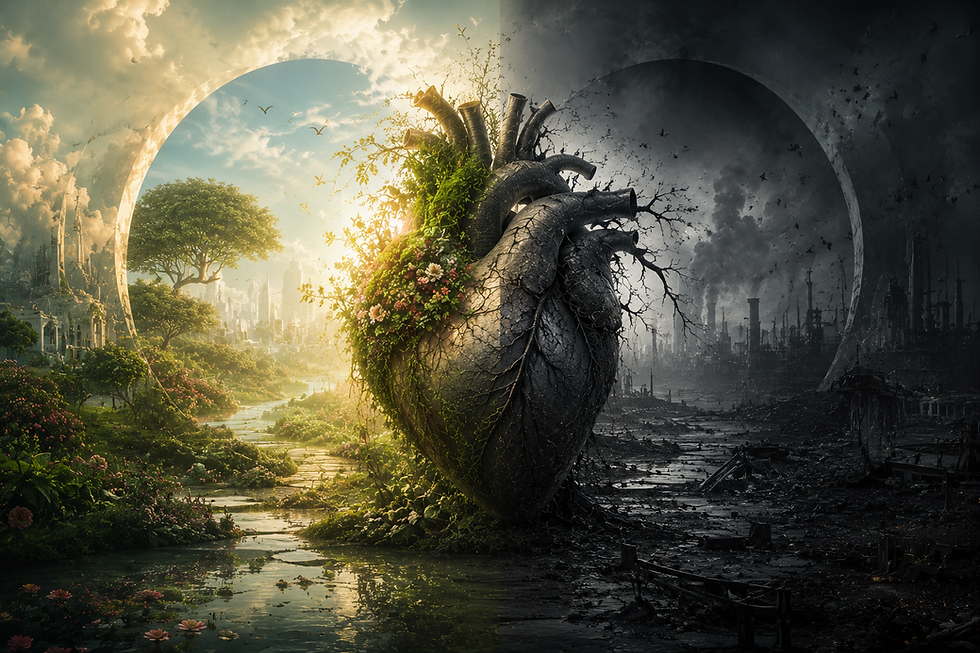
In the human body, circularity manifests in vital rhythms and anatomical structures. The heart pulses in closed circuits, the lungs follow regular respiratory cycles, circadian rhythms regulate sleep and wakefulness, and each joint moves along trajectories optimized for efficiency and stability. These biological cycles, while perfect, can create illusions if perceived as linear progress; orbiting around desires and habits without finding the center of one’s consciousness produces empty movement—seemingly orderly but lacking true significance.
The natural world, particularly gardens, offers a living metaphor for circularity and order. In gardens designed according to harmonious principles, winding paths, circular plantings, and round ponds replicate patterns of cosmic balance. Each plant, flower, and element of the landscape obeys cyclical rhythms: germination, flowering, fruiting, and decay constitute a cycle perfectly integrated within the ecosystem. Moving a brush in small circles to blend colors reproduces on a microcosmic scale what occurs in gardens and nature: distinct elements come together in visual and functional harmony, evoking universal symmetry.
Even in the cosmos, circularity governs structures and extreme phenomena. Accretion disks around black holes form vortices of matter orbiting toward the gravitational center, while the event horizon defines a spherical boundary beyond which nothing can escape. Light bent by gravitational lensing creates visible circles, tangible manifestations of space-time geometry. Planetary orbits, electron motion around atomic nuclei, and spiral galaxies all exemplify ordered circularity, demonstrating how the principle of the circle is omnipresent and governed by precise natural laws.
In the Qur’an, circularity also carries spiritual significance. Every creature glorifies God through its movement, like a vast cosmic Tawaf (Surah An-Nur 24:41; Surah Al-Anbiya 21:33). The human Tawaf, completing seven revolutions around the Kaaba, concretely manifests this principle: the believer places God at the center of their life, orbiting the divine, just as all creatures orbit within the cosmic order. The repetition of the seven circuits is not an empty ritual; it is a path toward perfection, a symbolic reference to the completeness of the number seven and to universal harmony.
Art and the practice of color reflect the same logic: circular brushstrokes blend distinct pigments, creating harmonious shades that replicate, on a small scale, the perfection of natural and cosmic cycles. In Indian mandalas, shamanic symbols, or Christian rituals, the circle becomes a tool for contemplation and connection between microcosm and macrocosm, matter and spirit, self and universe.
Integrating the garden metaphor, the circle also becomes a symbol of life and regeneration. Plants follow natural cycles, winding paths guide visitors around a visual or spiritual center, and the garden itself becomes a microcosm of the universe: a place where order, beauty, and harmony are perceptible in tangible form. Here, as in the Tawaf, a real center exists around which all revolves, and the perception of relationships among elements becomes both a cognitive and spiritual experience.
In conclusion, the circle is not merely a form: it is a universal law, an integrating principle, a metaphor, and a reality simultaneously. From the heartbeat to accretion disks, from circadian rhythms to planetary motion, from mandalas to designed gardens, from brushstrokes blending pigments to human Tawaf, every circle tells the same story: there is a center, there is order, there is harmony. Recognizing the center means distinguishing between illusion and reality, between empty motion and authentic progress, between apparent chaos and the invisible law of the universe. The circle is the hidden breath of the cosmos, the invisible map of life, and the key to perceiving the unity of matter, spirit, nature, and art.
Al-Muqīt — The Sustainer and Provident of all things.



Comments