In Our Minds and in the Universe: When The Qur’an Speaks of Worlds
Updated: Feb 16
“We will show them Our signs on the horizons and within themselves until it becomes clear to them that it is the Truth.”
Qur’an 41:53
Living in two worlds can frighten those who measure reality only through the senses. For those who truly do so, however, it is not madness: it is the ability to move between what we see and what exists beyond it, in the unseen worlds spoken of in the Qur’an. The real challenge is not crossing these dimensions, but helping others understand that they exist.
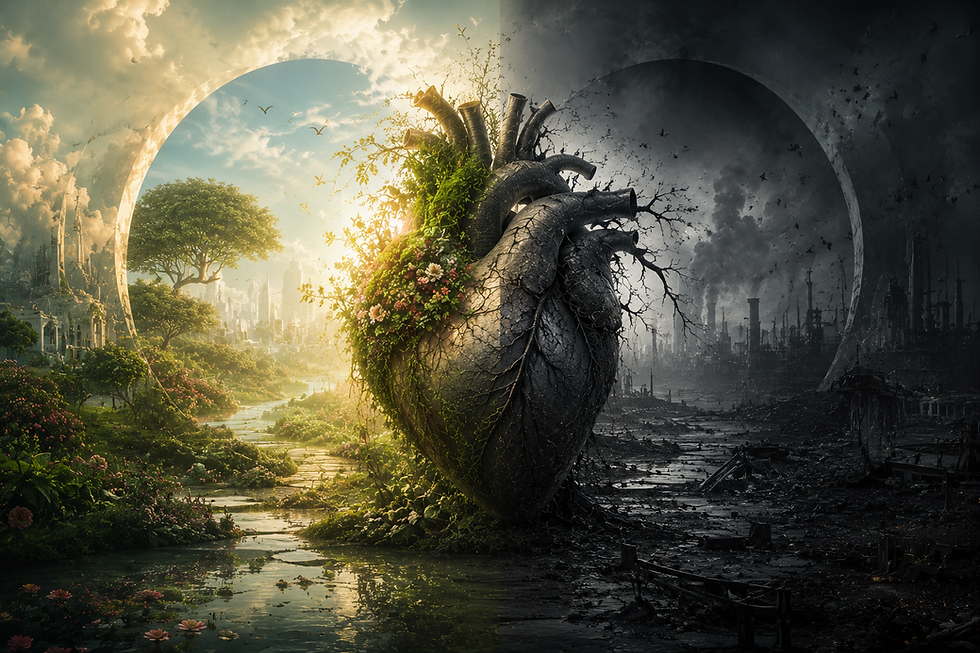
According to the Qur’an and Islamic tradition, there are multiple “worlds” or levels of reality. These are not parallel universes in the scientific or science-fiction sense, but spiritual and cosmological realities created by God (Allah). Today, when a person seems to access these dimensions naturally, they are often diagnosed with depersonalization or dissociative disorders and directed toward medications or therapies meant to “ground” them. But perhaps we are looking at the phenomenon from the wrong angle: perhaps flying is part of our nature, and the ability to traverse other levels of reality is not madness, but reality itself.
In the Qur’an, the word closest to “world” is ʿālam (عَالَم), which refers to realms or levels of existence:
al-ʿālam al-dunyā – the earthly world, everyday life and material trials;
al-ʿālam al-ākhirah – the Hereafter, Paradise and Hell, invisible to the living yet real according to faith;
al-ʿālam al-ghayb – the world of the unseen, which includes angels, jinn, and knowledge reserved for God;
al-ʿālam al-malakūt – the celestial realm of the angels, where divine laws manifest without mediation.
The Qur’an (41:53) says:
“We will show them Our signs on the horizons and within themselves until it becomes clear to them that it is the Truth.”
This suggests that there are levels of reality beyond human senses: the visible world is only a fraction of the universe created by God. Angels, jinn, and humans inhabit different worlds—coexisting and interconnected.
Yet today, those who access these inner worlds are often considered “disconnected from reality.” But what if these experiences were part of our true nature? If we were celestial beings, if our destiny one day is to move freely through dimensions and time, then clinical science might offer only a partial view of what is real.
Perhaps the problem is not those who see beyond the material world, but those who confine themselves to earthly life alone. Recognizing that our existence is only one stage of a much greater journey would change everything: suffering, priorities, even the very concept of normality.
We are souls waiting to be set free, sparks of light capable of crossing the universe. Looking beyond is not madness—it is part of who we are.


Comments