The Decomposition of Thought
- Nov 23, 2025
- 4 min read
Updated: 9 hours ago
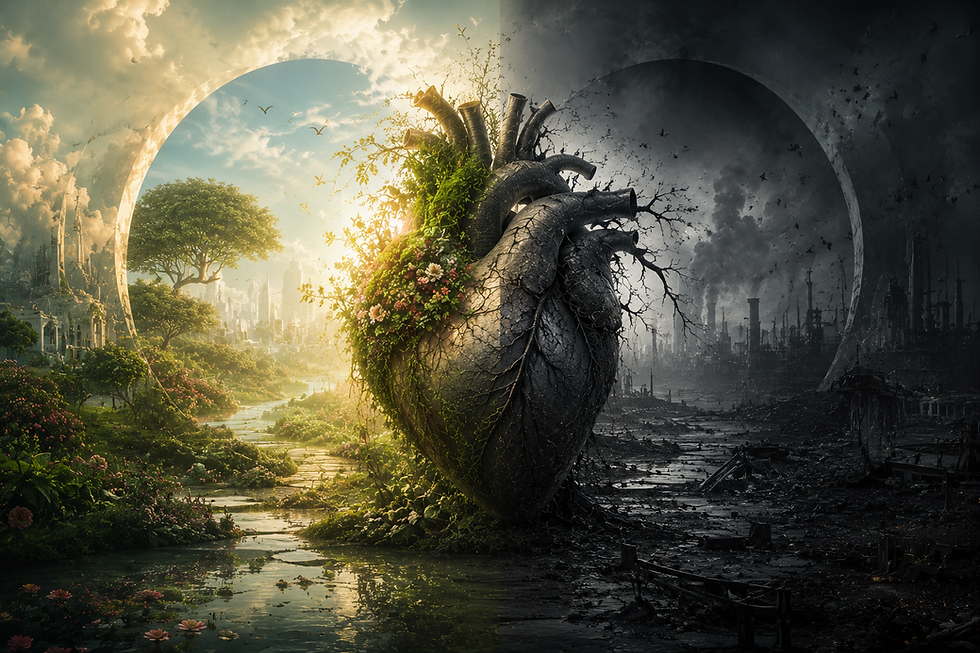
The body, when it dies, decays slowly: first the tissues, then the forms, until only bone and silence remain. Thoughts follow a similar fate. In grief they swell, rebel, and ferment like living matter; then, day by day, they unravel, lose weight, and fall away. What endures is the essence: a bare, fragile core that does not die but changes form. Just as the earth breaks itself apart to give life to the seed, thought too must decompose in order to be reborn.
When we reflect on loss, the mind often turns to stark biological images such as bodily decay. Though unsettling, this analogy becomes a powerful interpretive lens: discarded or exhausted thoughts undergo a gradual dissolution akin to the fate of organic tissue. As microorganisms and bacteria reduce the body to its skeletal form, the thoughts bound to sorrow move through phases of resistance, softening, and fragmentation until only their conceptual skeleton remains.
This is not merely a psychological event; it mirrors a wider law inscribed in life itself: every form emerges, flourishes, wanes, and returns in another shape.
The Qur’an urges human beings to contemplate this rhythm through the signs (āyāt) scattered across the cosmos and within the self¹. It frequently evokes the image of barren earth coming back to life, as in Sūrat al-Hajj (22:5), where the awakening of soil after rainfall becomes a metaphor for resurrection². In this view, decomposition is not a finality but a prelude to renewal.
This theme deepens in Sūrat Qāf (50:3–4): “When we are dead and turned to dust? […] Indeed, We know what the earth consumes of them.”³ Here, the dispersal of matter is framed not as divine absence but as an intimately known and purposeful process.
To those who question whether bones can live again, the Qur’an responds unmistakably in Sūrat Yā-Sīn (36:78–79): “He Who created them the first time will bring them back to life.”⁴ The point is not only divine power, but the rational invitation to observe nature, where regeneration is constant. Even the human body bears witness: the skeleton renews itself entirely over approximately ten years, echoing the Qur’anic vision of existence as ceaseless transformation. Thus, “We created man from an extract of clay” (23:12) and “Then after that, you will surely die” (23:15)⁶ present death as a threshold between forms, not an end.
Meditative practices learned in Indian āshrams—especially the art of observing thought without attachment—resonate unexpectedly with this Qur’anic perspective. If we are not identical with our mental content but can watch thoughts arise and dissolve, then inner change mirrors the dynamic architecture of creation. The Qur’an reminds us repeatedly of such stages: Sūrat al-Mu’minūn (23:12–16) outlines creation, death, and re-creation as a rhythmic, divinely set sequence⁵.
The kinship between sleep, death, and awakening, expressed in Sūrat az-Zumar (39:42), further illuminates this flow: “Allah takes the souls at the time of their death and those that have not died during their sleep.”⁷ Life is revealed not as a fixed state but as movement: each night we “die” and “return,” unaware. This natural cycle helps us understand the evolution of thoughts in grief, first defiant, then fragile, then dissolving—until they leave a space into which a new inner world must be built.
The Qur’an acknowledges that death, though subjectively painful, is essential to the journey toward renewed existence: “Every soul shall taste death” (3:185)⁸. The “taste,” however, marks a passage, not a disappearance. In the same way, emotional pain initiates an inner rebirth. When the thought that bound us to the beloved who is gone finally dissolves, what remains is our essence, a metaphysical core that endures through every transformation.
Love itself, often reduced to biology, cannot contain the full complexity of the human being. When the architecture of thought collapses, we find ourselves exposed, compelled to redraw the world from its foundations. It is a difficult stage, yet it is profoundly aligned with the Qur’anic principle that everything in created existence passes through birth, death, and renewal.
In the end, what we call “an ending” is merely a change of form. Mark Harmon has seen this in the logs he has studied for forty years: they do not die; they transform. They become friable clay, sand, new soil. They disintegrate to create space, nourishment, and regrowth. The same dynamic runs through our thoughts when pain fractures them: they ferment, resist, and then slowly dissolve until only an essential core remains, something from which renewal can begin.
The Qur’an acknowledges this law of transformation with a clarity that transcends centuries. Sūrat Ṭā-Hā states: “From the earth We created you, to it We will return you, and from it We will bring you forth once again” (20:55). This is the complete cycle: birth from the earth, return to the earth, regeneration. In Sūrat al-Ḥajj (22:5), the human being becomes dust; in Sūrat Yā-Sīn (36:78), one asks who could give life back to bones reduced to fragments; in Sūrat al-Mu’minūn (23:82), the question arises whether resurrection is possible when we have become “bones and dust.” The answer is not an exception to the natural world but an affirmation that nature itself embodies continual resurrection.
Thus, decomposition is not the opposite of life but its deepest logic. Whatever breaks apart is already preparing the form that will follow. The logs that become soil, the thoughts that return to sand, the bodies the earth receives and returns: all are held within the same law of return and renewal. There is no absolute loss, only transformation. And understanding this does not erase pain, but it makes it traversable: a passage, not an abyss.
Qur’an 51:20–21 — signs in the heavens and within the self.
Qur’an 22:5 — the earth revived by rain as a sign of resurrection.
Qur’an 50:3–4 — divine knowledge of what the earth consumes.
Qur’an 36:78–79 — response to doubt about the resurrection of bones.
Qur’an 23:12–16 — the cycle of creation, death, and re-creation.
Ibid.
Qur’an 39:42 — analogy between sleep and death as transitional states.
Qur’an 3:185 — the universal experience of death.
Le Scienze, novembre 2025



Comments