Seeing the World through Different Eyes
Updated: Aug 13
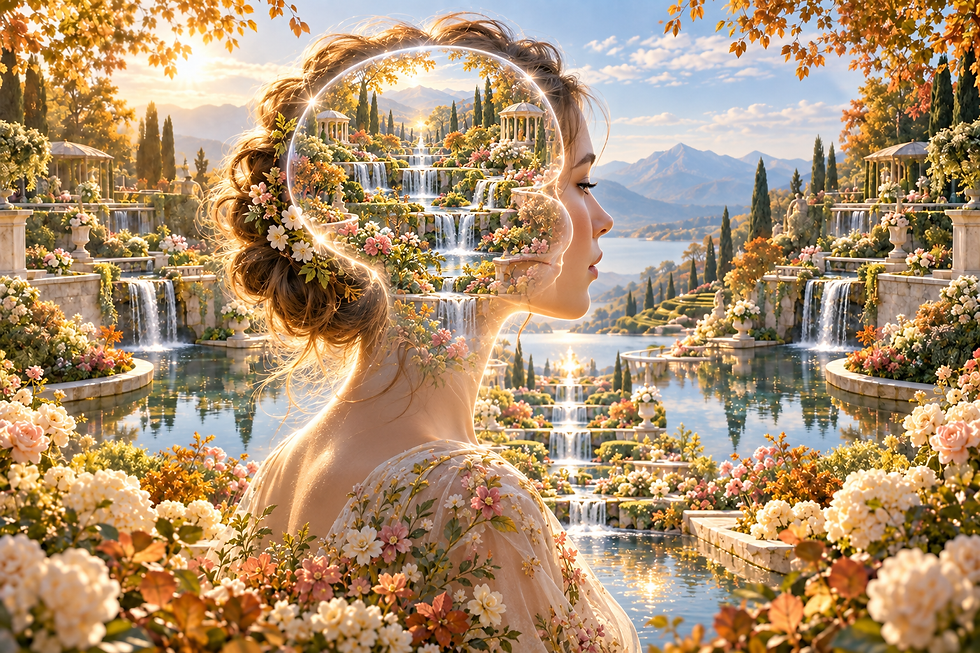
Autistic minds are often misunderstood as rigid, yet they perceive the world in multiple dimensions. They experience reality in layers, noticing connections that might escape others, seeing not only what is visible but also what lies beneath. Their thinking flows through multiple channels at once, integrating thoughts, emotions, and observations into a rich, expansive awareness.
The Qur’an provides guidance that resonates with this perspective, emphasizing human uniqueness and the diversity of creation. It reminds us that in the heavens, the earth, and all living beings, there are signs for those endowed with understanding and reflection (Surah 3:190-191).
These verses highlight complexity, diversity, and nuance, inviting contemplation of a reality that is not simply black or white. Knowledge, morality, and consciousness operate across a spectrum of shades, colors, and dimensions.
Colors in the Qur’an are more than just visual phenomena, they symbolize richness, diversity, and the subtleties of creation. Surah Fatir (35:27) invites reflection on the variety of colors in fruits, mountains, and life itself, showing that diversity is a sign of divine wisdom. Surah Ar-Rahman (55:64) describes lush gardens with deep green tones, representing vitality, abundance, and life. Just as every color contributes to the harmony of the world, every mind contributes to the richness of existence.
Autistic individuals, like the colors of creation, embody uniqueness and nuance. They are not in need of a “cure,” because neurodiversity is not a disorder, but a way of being. Their minds are attuned to complexity, capable of perceiving and integrating vast layers of experience. Homogenized or repetitive environments may feel stifling, not because of inflexibility, but because such contexts fail to engage their full cognitive and sensory capacity.
Technology can be a bridge, enabling autistic individuals to communicate, create, and express themselves without forcing conformity. They often excel in analysis, invention, and artistic creation, processing the world with depth and precision.
Sensory sensitivity, intense perception, and profound reflection are part of their experience, but so is resilience. Like a spectrum of colors, autistic minds add depth and beauty to the human collective.
Listening to Qur’anic recitation can support emotional and cognitive balance. Studies show it reduces stress, promotes relaxation, and increases neural coherence. In this sense, the Qur’an acts as a guide, inviting reflection and awareness, encouraging us to perceive the full spectrum of human experience, and to recognize the signs of creation in all their richness.
Being on the spectrum is like existing at the center of a vibrant continuum. Life is never just black or white—it is a vast spectrum of colors, dimensions, emotions, and ideas. The Qur’an guides us to honor this spectrum, showing that neurodiverse minds are not outside creation—they are an integral part of it, like colors woven into the infinite tapestry of the universe.



Comments