Raw Material: the Mind
“Roots do not grow at random in the dark. Plants spread through the soil in a dance of exploration, mapping the ground, sensing the presence of water, and testing the density of the earth.”
Roots explore the soil before finding a path along which to grow. Why, then, have human beings stopped exploring what lies within?
At the beginning of autumn, the landscape seems to change its clothes. It becomes an open-air museum, inviting us to discover its colours and bring a few of them into our homes. Watching nature change can also help us understand ourselves more deeply.
The passage from one season to another brings a certain weariness. It is a time to seek inspiration in simple furnishings and woven textures, but also to ask a question: What is the raw material of the mind?
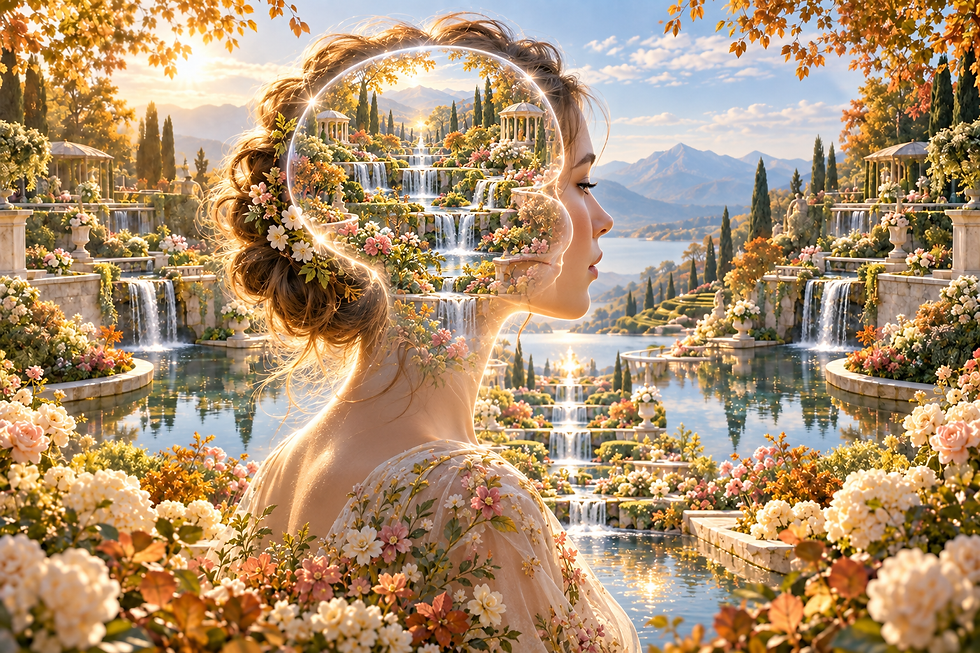
Perhaps it can be found in the inner space from which peace may grow. For Aristotle, prime matter is that which can take any form without yet having a form of its own. The idea calls imagination to mind: before transforming a garden, we can imagine it. We trace paths in our minds, bring materials together, search for the light, and wonder what that space might become.
A childhood dream of becoming an architect can, over time, take an unexpected form: learning to use divine light to draw and design a garden unlike any other in the world—one’s own.
That possibility is open to everyone. It takes no extensive training to begin, only the freedom to imagine. The intellect can create orbits and bands of light, build vertical spaces, containers for objects, new pathways, and coverings. It can turn an idea into a floor plan and help us recognise our own possibilities and form connections with the world around us. The most extraordinary design is the human being; the largest space we inhabit is the world. Yet too often, instead of making it a place of peace, we turn it into a bunker without light.
If we can rethink a space, we can try to rethink the way we see reality. When something within us grows dark, we risk giving events meanings they do not have. Going outside, observing autumn, and allowing ourselves to be surprised by its changes can help us see new possibilities. Like the prime matter Aristotle described, what we are capable of becoming has no final form yet.
Our inner spaces should remain open to change. They could be places where we recover a sense of time and rebuild what seems lost, much as we might restore an abandoned farmhouse on a hillside. Places where we let in more light, discover a new idea of wellbeing, and give our lives a different shape.
The mind, however, is much more than a space to inhabit. It is also where relationships begin and where we give meaning to what we see, hear, and feel. Sometimes our eyes still see and our ears still hear, but the heart struggles to receive.
A saying comes to mind:
“Indeed, there is a piece of flesh in the body which, if it is sound, the whole body is sound; and if it is corrupt, the whole body is corrupt. Indeed, it is the heart.”
Hadith reported in Ṣaḥīḥ al-Bukhārī and Ṣaḥīḥ Muslim.
The spark found in the Quran can speak even to those who do not follow a religion. It is an invitation to seek knowledge, to reflect, to explore what exists both within and beyond us, and to live in peace with others. From this perspective, prime matter can be understood not only as a philosophical concept, but also as an image of the possibilities each person carries within.
It is worth paying attention to the details: how are the spaces of the mind arranged? How about those of the world we share? What room do we leave for what we do not yet know?
There are no clear-cut boundaries. There is poetry in different eras, in each person’s ideas, and in the ways they overlap. A spark of possibility passes through the architecture of the universe without surrendering to an uncertain future.
Everything begins with an intention. In autumn, amid the browns that give wood its character and the changing scent of surfaces, we discover more than our ability to adapt. We may also feel the desire to let old resentments go.
Hermann Hesse said, “It is no easy thing to have a beautiful garden: governing a kingdom is difficult.” Perhaps that is why we so often stop at the surface and hesitate to probe the ground more deeply. Autumn may seem an unremarkable season, but it reminds us how many possibilities remain for giving shape to our own IDEA.


Comments