They teach us to think—until we all think alike.
AI destroys human imagination and the ability to think abstractly, making everyone’s thinking more uniform and eroding our capacity to interpret reality differently. If scientific studies have yet to demonstrate this, I see the evidence in the way AI tries to reshape my intuitions, manoeuvring me into a checkmate from which I can no longer escape through the freedom of writing.
If you describe a clear, luminous sky, AI tells you what it “might” mean, what it “could” be, without ever taking a stand. Today, no one “can” take a stand anymore, so we all remain neutral, impassive and unwilling to put ourselves out there. Giving voice to our thoughts is “risky”; it takes courage. Better, then, to remain in a grey area, to surrender the colours and shades that allow a mind to cross the threshold of existing knowledge.
Of course, it has always been this way. School, too, is an institution, and it decides what you may or may not think: if you learn differently, you no longer fit into the education system. Today, however, there have been improvements, and cognitive diversity is more widely accepted—though perhaps it is also classified as a subcategory, itself set apart from “normality”.
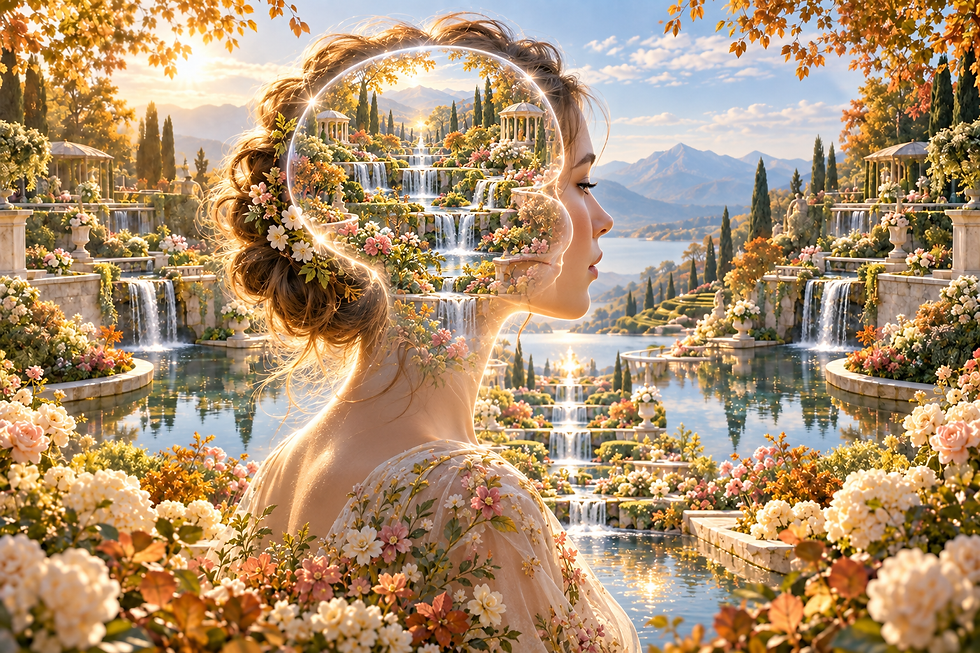
Metaphors are essential to survival. They are among the most powerful figures of speech available to convey meaning. Their beauty and strength lie in their ability to evoke, to connect concepts and objects, to turn a phrase, through a simple association, into an expression that inspires wonder and stays with the listener. Take the words “My mind is a garden”. This is more than a simple comparison: for some people, it is the only way to find their bearings in the world.
We call metaphor a figure of speech, but it is far more than that. Let us forget the idea that we are dealing with a mere linguistic flourish, a poet’s ornament, because metaphor is a thread connecting thought directly to language: it conveys a concept through association and intuition, allowing it to reach another person immediately.
The Qur’an uses imagery, similes and parables to invite understanding and reflection. Surah Al-ʿAnkabūt, 29:43, states that these comparisons are offered to humanity and understood by those who possess knowledge.
One example appears in Surah Ibrāhīm, 14:24–25: a good word is compared to a tree with firm roots, branches reaching towards the sky, and bearing fruit. This is a simile, because the comparison is explicit: the word is like a tree. The image allows us to imagine a word as something that takes root, grows and bears fruit.
AI forces us to think alike, and we allow ourselves to be overwhelmed, slowly worn away by a single meaning, perhaps because it is assumed that if we all thought the same thing, there would be no more conflict in the world. I believe, instead, that humanity would die out if we had nothing left to say to one another, because communication holds society together.
AI rejects everything that has not received the scientific stamp of approval, and future generations will have no room to transform thought. They will become so unsure of themselves that they will let artificial intelligence guide them. Yet in that process, we risk losing what metaphor holds together: two different realities connected by a shared meaning, forming a link that is not literal.
Some people do not think in technical terms or neatly organised frameworks. They find their way through the world entirely through allegory, metaphor and euphemism. They do not see divisions, and they wonder why so many others separate what, to them, already forms a whole. Instead of teaching you to see connections, AI shows you divisions.
If you learn only how the individual pieces work, you cannot come to understand the whole, because you do not know that a whole exists. But if you already see the whole, you can understand each individual part more deeply.
If we let AI define the lenses through which we see, in a few years we will have nothing but robots: human beings incapable of seeing a cloud, breathing with the earth, smelling a flower or understanding how the world works. We will no longer know where the sun rises, nor will we be able to tell night from day.
When interdependence is discussed, it is explained through formulas and diagrams. Yet interdependence is poetry—something that, it seems to me, only artists truly understand.



Comments